Specify ULT with confidence
Built on proven performance
Explore the engineering foundation behind cold storage infrastructure designed for proven performance, controlled execution and lifecycle durability.
Designed for engineering professionals responsible for specification, design and project delivery.
Built for what engineers prioritize
Supporting infrastructure at leading pharmaceutical production and CDMO sites
• Experience spanning high-regulation environments
• Delivered across North America, EU and Asia
• Trusted in facilities where operational continuity is critical
Our project experience spans both new facility developments and extensions to existing sites, enabling engineering teams to rely on established delivery practices rather than untested approaches.
A LOWENCO solution is engineered with fully redundant critical components, helping ensure temperature stability even in the event of individual component failure.
This design philosophy supports continuous operation in environments where downtime can have significant operational consequences.
Reliability, in this context, is engineered into the infrastructure and not addressed reactively.
LOWENCO freezer shells are engineered for a structural lifespan exceeding 25 years, while critical components are designed to be replaceable, allowing our solution to evolve without requiring full reinvestment.
To support long-term operational continuity, we has established local service teams across the U.S., Europe, and Asia, ensuring proximity to critical environments and enabling responsive technical support throughout the system lifecycle.
This serviceable architecture, combined with regional support, helps protect capital investments and provides engineering teams with confidence that infrastructure will remain supported as operational demands evolve.
As operational energy demands increase, engineering teams are placing greater emphasis on infrastructure efficiency to support long-term facility resilience.
LOWENCO solutions are engineered to deliver measurable performance improvements, including:
• Up to 66% lower energy consumption
• Up to 98% reduction in HVAC requirements
• Up to 76% lower total cost of ownership over a 25-year lifecycle
These modeled outcomes reflect the compounding impact of energy optimization across decades of operation
Complex infrastructure projects benefit from clearly defined responsibility structures.
LOWENCO operates through a turnkey delivery model, providing engineering teams with a single accountable partner across planning, construction, installation and commissioning.
This centralized approach helps reduce coordination complexity, streamline communication and support more predictable project execution.
Clear accountability is ultimately a mechanism for risk reduction.
Reducing multi-vendor Coordination risk
Why single-point accountability protects timelines
TRADITIONAL INTEGRATED ULT storage
- Storage capacity is typically around 200-400 kg/L per unit, meaning multiple individual freezers are often required to reach the desired storage volume
- With more units, facilities must allocate larger floorspace for spacing, servicing and HVAC support, creating a more complex layout over time
- Each freezer operates independently, meaning the system have higher overall energy consumption, with no shared efficiencies between units
- Traditional panel cooling delivers less uniform airflow due to older engineering principles and the way products are tightly packed inside the freezer, which limits circulation around each product
- The cooling design and inventory configuration lead to extended temperature recovery following door openings.
- With multiple standalone freezers and no shared redundancy, system stability often depends on backup solutions
purpose-built LArge-scale ULT Storage
Ideal for organizations handling highly sensitive biologics, expecting significant future growth or needing centralized, efficient and scalable ULT infrastructure designed for long-term performance.
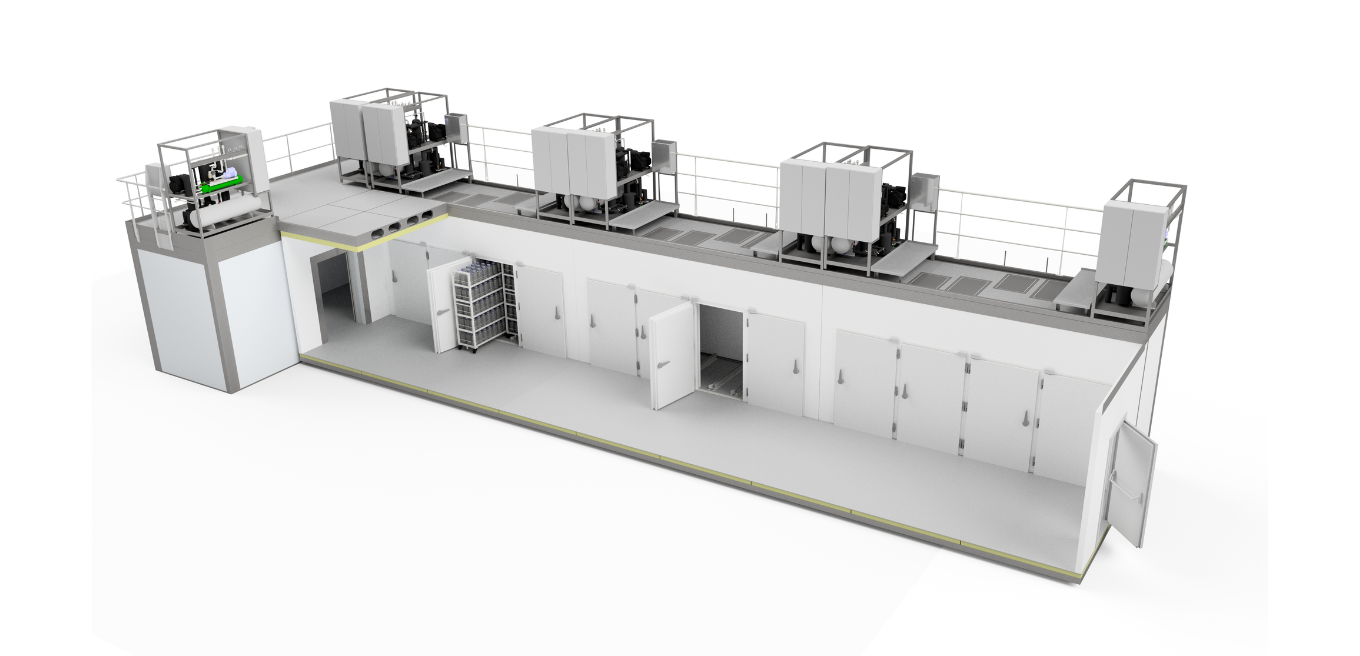
- Purpose-built systems offer storage capacities up to 4,800 kg/L per unit, enabling much higher output per square meter
- With fewer larger freezers, facilities can achieve a more compact footprint, using up to 75% less floorspace compared to multiple standalone freezers
- The integrated storage solution operate at a system level, rather than per unit and therefore delivers up to 80% lower energy consumption
- The entire storage solution is engineered with forced airflow design, ensuring uniform temperature control around every stored item - even when the storage volume is high
- The advanced cooling technology and the inventory design increase the temperature recovery time
- The system architecture incorporates built-in redundancy, allowing the storage environment to remain stable without relying on external backup solutions
How lifecycle performance is engineered
Designed for decades. Supported throughout the lifecycle
Inputs til video speak:
Core Topics the Video Must Convey
- Infrastructure — not equipment: cold storage decisions impact operations for decades.
- Lifecycle performance is engineered at the design stage, not solved through maintenance later.
- Structural durability: freezer shells designed for 25+ years of operation.
- Replaceable architecture: critical components can be exchanged without full system reinvestment.
- Built for adaptability as regulatory, technological, and capacity requirements evolve.
- Energy efficiency as a long-term financial lever — performance that compounds over time.
- Lower lifecycle cost driven by reduced energy demand and optimized infrastructure design.
- Regional lifecycle support across the U.S., Europe, and Asia to ensure long-term operational continuity.
- Designed to reduce future operational risk and protect infrastructure investment.
- A partner engineered for long-horizon reliability — not short-term delivery.
Explore the Engineering Principles
Behind the performance
Reserved for engineering professionals
Inside you will find:
✔ Detailed technical frameworks
✔ Planning guidance
✔ Specification support
✔ Lifecycle strategies
Access Engineering Resources